Cultural Heritage Law
Introduction
The Nautical Archaeology Digital Library (NADL) started in 2006 as a repository of information useful to nautical archaeologists and 15 years later is trying to become a node in a global network of internet resources conceived to share reliable information with students and archaeologists around the world. This section provides information to both professionals and the public in general about ethical and legal protections of the world's cultural heritage.
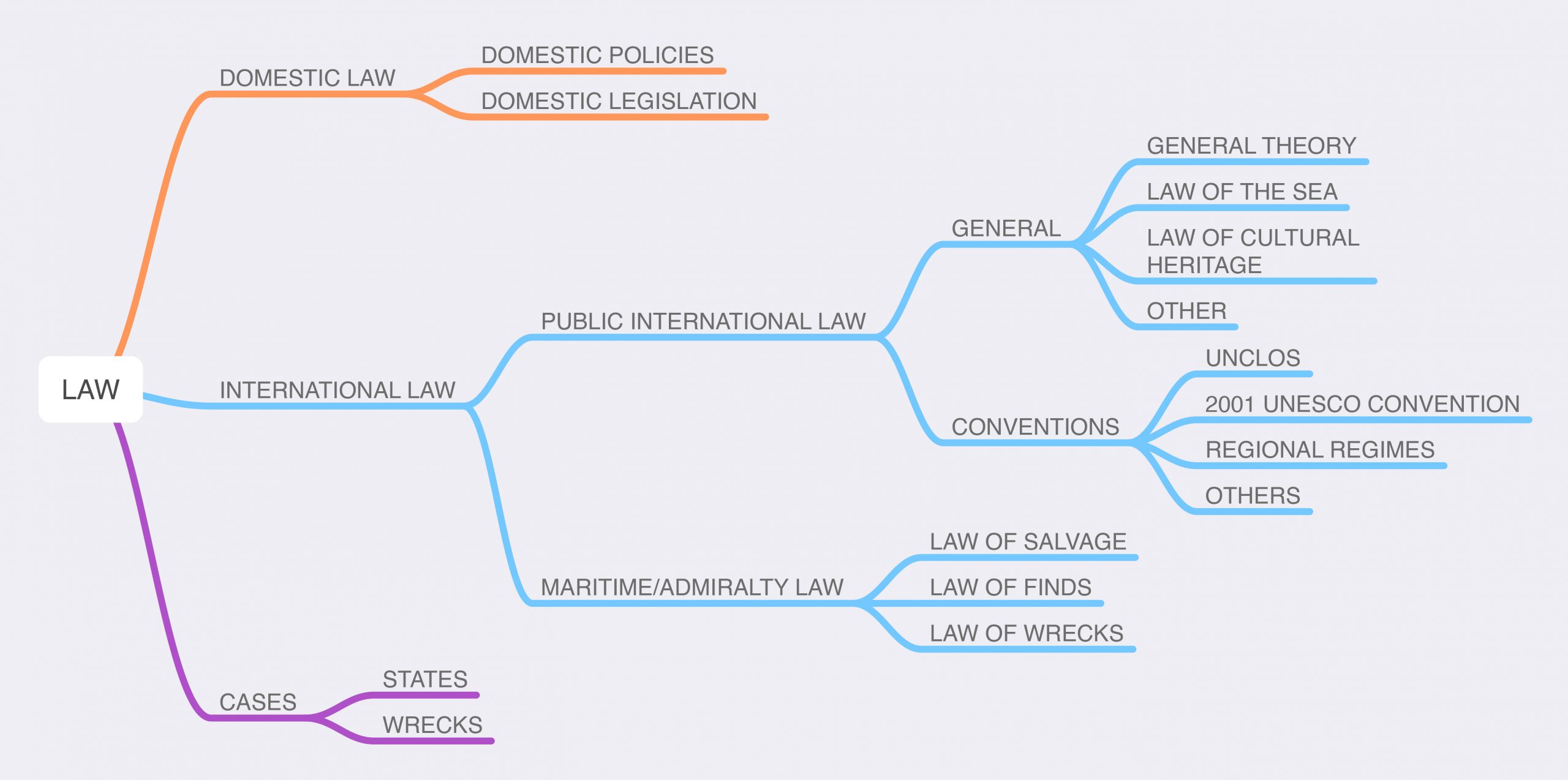
Law
The sources of domestic law or rules of a nation are generally found in statutes, codes, and the regulations of a particular nation. They may be further explained in administrative policies or in the cases of courts or administrative tribunals.
International Law: Public and Private
International law is the law agreed to between two or more nations. The sources are generally recognized practice of nations (customary international law) and treaties or conventions which are only binding on those nations that have become parties. Public international law includes those conventions regarding the activities and obligations of the national governments such as the 2001 UNESCO Convention. Private International Law pertains to private activities of companies or persons such as the maritime law of salvage. The public interest in protecting our cultural heritage is reflected in the international and domestic laws to protect it.
Public International Law
UN Convention on the Law of the Sea
The 1982 UN Convention on the Law of the Sea is one of the most comprehensive and widely accepted international agreements. It has a constitutional nature providing the legal framework for the conduct of activities at sea, reflecting a careful balance of the corresponding rights, jurisdiction, and authority of coastal and flag States. However, it only has two short and very general articles on heritage, Articles 149 and 303.
Article 149 recognizes the general legal principle for "objects of an archaeological or historical nature" in the "Area" beyond the jurisdiction of nations. It says that this underwater heritage must be "preserved or disposed of for the benefit of mankind as a whole."
Article 303(1) recognizes that States have a general duty to protect heritage found at sea and shall cooperate for that purpose.
2001 UNESCO Convention on the Protection of Underwater Cultural Heritage
Link to 2001 UNESCO Convention
The 2001 Convention is the most comprehensive agreement to date to recognize and incorporate the UNCLOS framework and provide the needed details, standards and requirements for compliance in a manner consistent with it. A primary purpose of the 2001 Convention was to build on the legal framework of UNCLOS and provide details for implementing the duty to protect "objects of an archaeological or historical nature" and to cooperate for that purpose.
Other Relevant Conventions
- 1954 (Hague) Convention for the Protection of Cultural Property in the Event of Armed Conflict - Link
- 1970 UNESCO Convention on Trafficking of Cultural Property - Link
- 1972 UNESCO World Heritage Convention - Link
- 2003 UNESCO Convention on the Protection of Intangible Cultural Heritage - Link
Private International Law (Maritime Law of Salvage)
Maritime law is the substantive law that governs private maritime matters including salvage. It consists of both domestic and private international law. Maritime law dates back centuries to the time of ancient Egyptian, Phoenician, and Greek ports due to the need for uniform rules for activities at sea and spread to Europe and beyond along with trade and commerce.
1989 IMO International Convention on Salvage
In 1989, under the auspices of the International Maritime Organization (IMO), the States interested in unifying the maritime law of salvage adopted the International Convention on Salvage. Consistent with the long practice of nations, the Salvage Convention applies to recent maritime casualties, and not to submerged heritage resources that have been incapable of navigation for decades if not centuries.
Article 30(1)(d) of the Salvage Convention states that "[a]ny State may, at the time of signature, ratification, acceptance, approval, or accession, reserve the right not to apply the provisions of this Convention [...] when the property involved is a maritime cultural property of prehistoric, archaeological or historic interest and is situated on the sea-bed."
2007 IMO Nairobi International Convention on the Removal of Wrecks
A primary purpose of the 2007 International Convention on the Removal of Wrecks is clarifying the coastal State's authority to address threats to navigation and marine pollution from wrecks outside its territorial sea from a sunken or stranded ship.
Regional or Bi-Lateral International Agreements
International Agreement on RMS Titanic
The Law protecting RMS Titanic is highlighted as it is perhaps the most famous shipwreck. It is subject to the 2001 Convention as well as an International Agreement between the United Kingdom and the United States. As it is located on the seabed under the high seas, it is a potential model for high seas Marine Protected Areas.
The Barcelona Convention (1976)
The Barcelona Convention was adopted in 1976 as the first-ever Regional Seas Programme under the United Nations Environment Programme. Its main objectives include protecting the natural and cultural heritage of the Mediterranean.